AI Credits vs Tokens: Two Billing Dialects, One Operator Ledger
AI credits vs tokens are two billing dialects. Translate a credit pack into measured jobs, price the same jobs at token rates, and keep one burn-rate ledger.

Go deeper. Build your own.
Open the AutoClaw homepage in a fresh browser and a modal lands before the page does: new users get 100 million tokens, a countdown clock under the offer, a download button that doubles as the claim button. One tab over, DeepSeek’s pricing page is a table of decimals with a footnote about which UTC hours count as peak. Both pages price an agent’s work. Neither can be read in the other’s units.
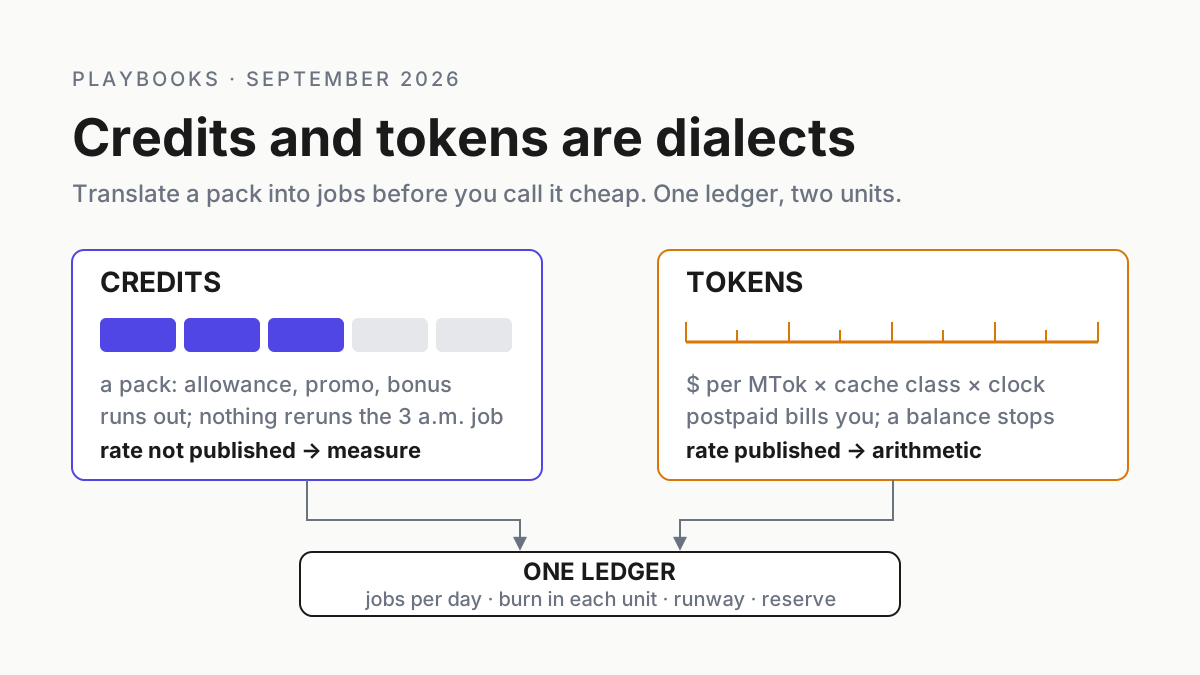
That is the AI credits vs tokens problem in one screen. Credits and tokens are two billing dialects, and the operator mistake is comparing the headline number of one with the headline number of the other, as if a 10,000-credit promo and a $0.30-per-million cache-miss rate were two prices for the same thing. A token rate is a price per unit of work the vendor can count. A credit is a unit the vendor defines, spends on your behalf at a rate it may or may not publish, and hands you in a pack that runs out.
The drill below does not invent an exchange rate; AutoClaw does not publish one, and a made-up one is worse than none. It translates a credit pack into jobs by measuring, prices the same jobs on the token side at published rates, keeps both in one ledger of burn per day, and decides in advance what a balance at zero does to the work you scheduled for 3 a.m.
Aug 26–27, 2026: a credit promo on one side, a rate table on the other
On Aug 26, 2026, the AutoClaw account on X named the Ox Alpha model as GLM-5.3-Flash, now available in the app, with rewards running Aug 27–30. The next day’s changelog entry, v1.17.8 of Aug 27, 2026, carried the promo in the vendor’s own words: “Limited-time offer:Log in to claim 10,000 credits,100% credit refund for GLM- 5.3-Flash and Auto Mode”. The homepage adds the new-user line, “New users register & log in to get 100‑million GLM‑5.3‑Flash tokens, worth $12”, and answers its own pricing question in the FAQ: “AutoClaw offers free basic usage and daily free credits.” and, two sentences later, “Paid plans are available for heavier usage.”
What the site does not carry matters as much. The plan button opens a modal saying plans are coming soon. The models page lists five models and no prices or credit costs.
The monthly bonus credits (5,000, 10,000 and 26,000) belong to the three GLM Coding Plan tiers that AutoClaw honours, not to AutoClaw plans of its own. Nowhere is there a number that turns a credit into a token or a dollar.
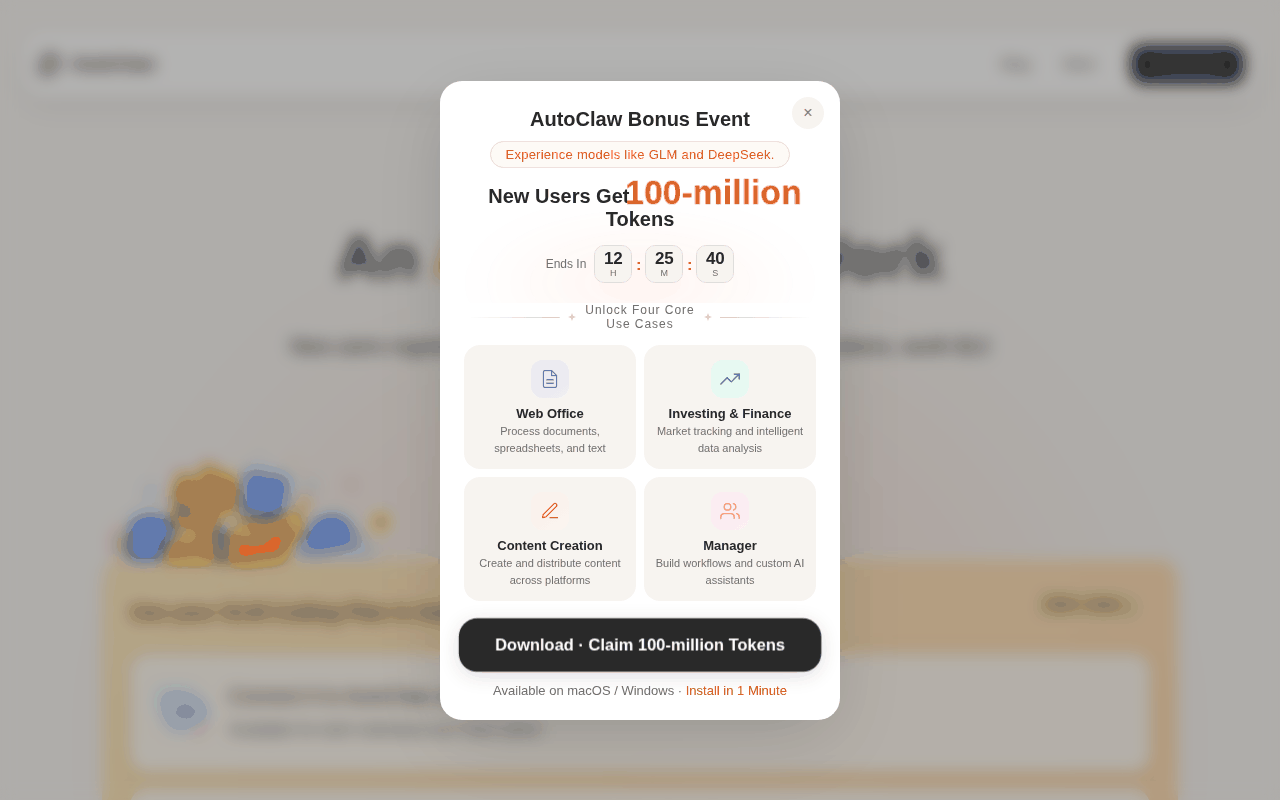 Screenshot: autoclaw.z.ai, “AutoClaw - Z.ai’s Official AI Agent | GLM-5.3-Flash Now Live” (no date on page), captured Sep 19, 2026.
The token dialect is DeepSeek’s pricing page after the V4.1-Flash release of Sep 10, 2026. For deepseek-flash, per million tokens: cache hit $0.006 at peak and $0.003 off-peak; cache miss $0.30 and $0.15; output $1.20 and $0.60. Footnote (2) defines the clock: “Off-peak rates are half of the peak rates. Peak hours are 01:00 - 04:00 and 06:00 - 10:00 UTC, Monday through Friday, excluding Chinese public holidays. All other hours are off-peak, including weekends and Chinese public holidays in full.” And the deduction rule is one line: “The expense = number of tokens × price.”
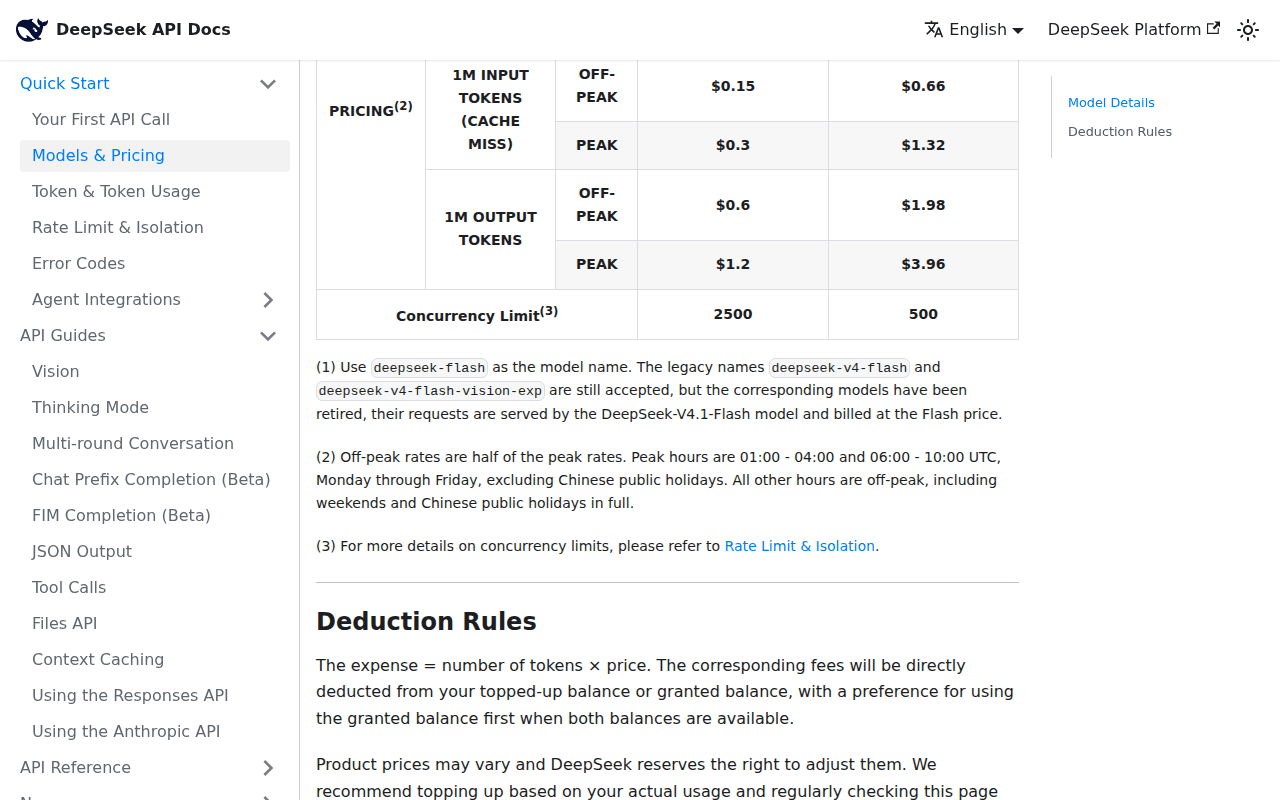 Screenshot: DeepSeek API Docs, “Models & Pricing” (page undated), captured Sep 19, 2026.
Everything an operator needs to price a token job is on that one page. Nothing an operator needs to price a credit job is on the other. That asymmetry is the whole subject.
Why an acting agent makes the dialect gap expensive
A person in a chat window spends credits at the speed of typing and notices when they run low. An agent on a schedule spends them at the speed of its tool loop, overnight, with nobody watching, and on a credit meter the balance is the only thing standing between the schedule and silence. On a postpaid token meter the same overrun turns into an invoice, a different failure with a different fix. Two dialects mean two failure shapes, which is why they need one ledger, not two dashboards.
There is a second axis hiding under the first. A dialect has a unit (credit or token) and a wallet (prepaid pack or postpaid account), and the wallet decides what exhaustion means.
| Vendor surface | Unit | Wallet | What is published | What is not |
|---|---|---|---|---|
| AutoClaw desktop | Credits (plus token-denominated promos) | Prepaid: daily allowance, promo packs, monthly bonus | Promo sizes; “worth $12” for 100 million GLM-5.3-Flash tokens | Any credit-to-token or credit-to-dollar rate; the daily amount; paid plans |
| Kimi Work desktop | Credits | By plan (the help pages say no more) | That widget-task concurrency “varies by plan”; that a scheduled-tasks page froze “when credits ran out” (fixed in 3.2.7) | The per-plan limit; the credit cost per run |
| DeepSeek API | Tokens, by cache class and clock | Prepaid balance: topped-up and granted, granted spent first | Every rate; the peak window; the deduction rule | A list of Chinese public holidays; a cache TTL guarantee |
| Anthropic via AWS or Azure Marketplace | Claude Consumption Units, $0.01 each | Postpaid: “Arrears only (postpaid); no prepaid credits” | The CCU price; that discounts apply at the token-to-CCU conversion | Nothing material; a credit unit with a fixed price is a token bill in costume |
| OpenAI API and Agents API | Tokens, tools and container minutes | Account billing; the pricing page does not say prepaid or postpaid | Every rate | Whether idle sandbox time bills |
Read the table by column three. Prepaid credits stop the work; postpaid tokens send a bill; a prepaid token balance does both, in that order. The three-meter inventory covers the metered-API side; this piece covers the prepaid packs and the translation they need.
Step 1: Name the dialect and the wallet for every agent on the desk
One line per agent, before any comparison. The shape is small enough to keep in the same file as the digital-employee inventory:
# illustrative: dialect register, one entry per agent on this desk
- agent: autoclaw-research
  dialect: credits          # unit the vendor deducts
  wallet: prepaid           # pack | balance | postpaid
  rate_published: false     # no credit-to-token rate on autoclaw.z.ai
  packs_held: [daily-allowance, promo-10000-credits]
  scheduled_work: [morning-brief-0630, competitor-watch-hourly]
- agent: deepseek-flash-batch
  dialect: tokens
  wallet: balance           # topped-up + granted, granted first
  rate_published: true
  clock: peak 01:00-04:00, 06:00-10:00 UTC Mon-Fri; else 50%
  scheduled_work: [overnight-doc-summaries]
- agent: fable-51-review
  dialect: tokens
  wallet: postpaid          # e.g. via AWS Marketplace CCUs, billed in arrears
  rate_published: true      # $10 in, $0.25 cache read, $12.50 5-min write, $50 out
  scheduled_work: []
Two rules for the register. rate_published: false is a fact about the vendor, and it means the next step is measurement instead of arithmetic. And scheduled_work is mandatory, because the reason to know a wallet is prepaid is to know which schedules die when it empties.
Step 2: The translation drill, credit pack to jobs, without an exchange rate
The drill turns a pack into the number of jobs to expect from it; it takes an afternoon and three runs per job shape.
- Pick three job shapes you actually schedule. A small one (a morning brief), a medium one (summarize a 40-page document), and the long one you care about (an overnight browser research run). Write each as a fixed prompt with fixed inputs so a run is repeatable.
- Record the balance, run the job, record the balance again. On AutoClaw the changelog’s v1.15.3 entry of Aug 4, 2026 says “Hover to view detailed model consumption statistics, making cost tracking more transparent.” Use that view, and also note the pack balance before and after, because a consumption statistic and a deduction are not guaranteed to be the same number.
- Run each shape three times, take the median. Agent runs vary; a research job that finds more pages spends more. Three runs tells you whether the spread is small or the job is a lottery.
- Divide the pack by the median. 10,000 credits divided by the median credits per run is the number of runs the promo buys. Days per pack is that number divided by runs per day on your schedule. Write both next to the pack.
- Re-measure on every trigger. A model switch (Auto Mode versus a named model), a promo ending, an app update that touches deduction (v1.16.2 of Aug 10, 2026 lists “Fixed model switching, credit deduction, and Gateway connection issues”), or a plan change. Any of these can change credits per run with nothing visible in the prompt.
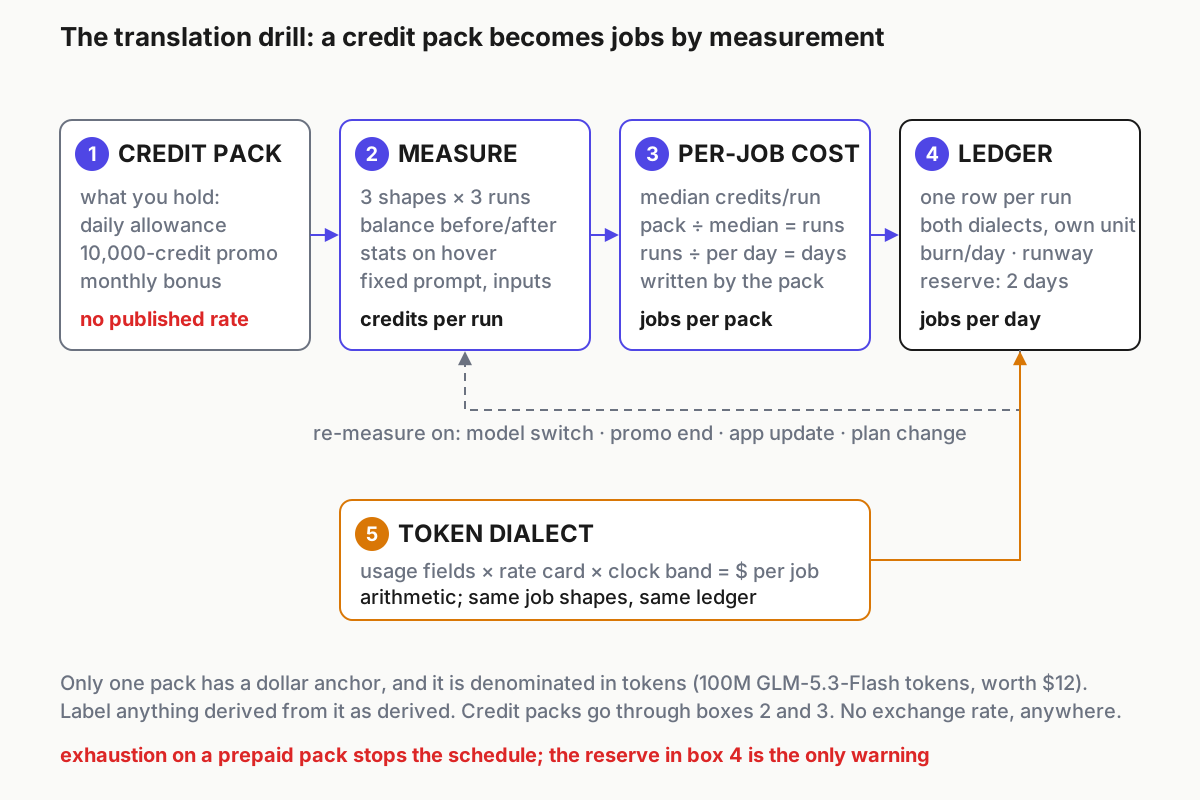 The translation drill. Credits become jobs by measurement; tokens become jobs by arithmetic; both land in the same ledger.
Exactly one pack on the AutoClaw site has a dollar anchor, and it is denominated in tokens rather than credits: 100 million GLM-5.3-Flash tokens, worth $12. Derived from that promo, and only from it, the vendor values a million Flash tokens at about $0.12. That derived figure lets you price a token-shaped job against the promo pack, which the chart below does. It says nothing about what a credit is worth; the 10,000-credit promo, the daily allowance and the monthly bonus credits have no anchor, and for those the drill is the only translation there is.
Step 3: Run the job-shaped bakeoff, not the headline-rate bakeoff
The bakeoff prices four job shapes on the token side at published rates and on the promo side at the derived anchor. The numbers are illustrative; the rates and the anchor are the vendors’ own.
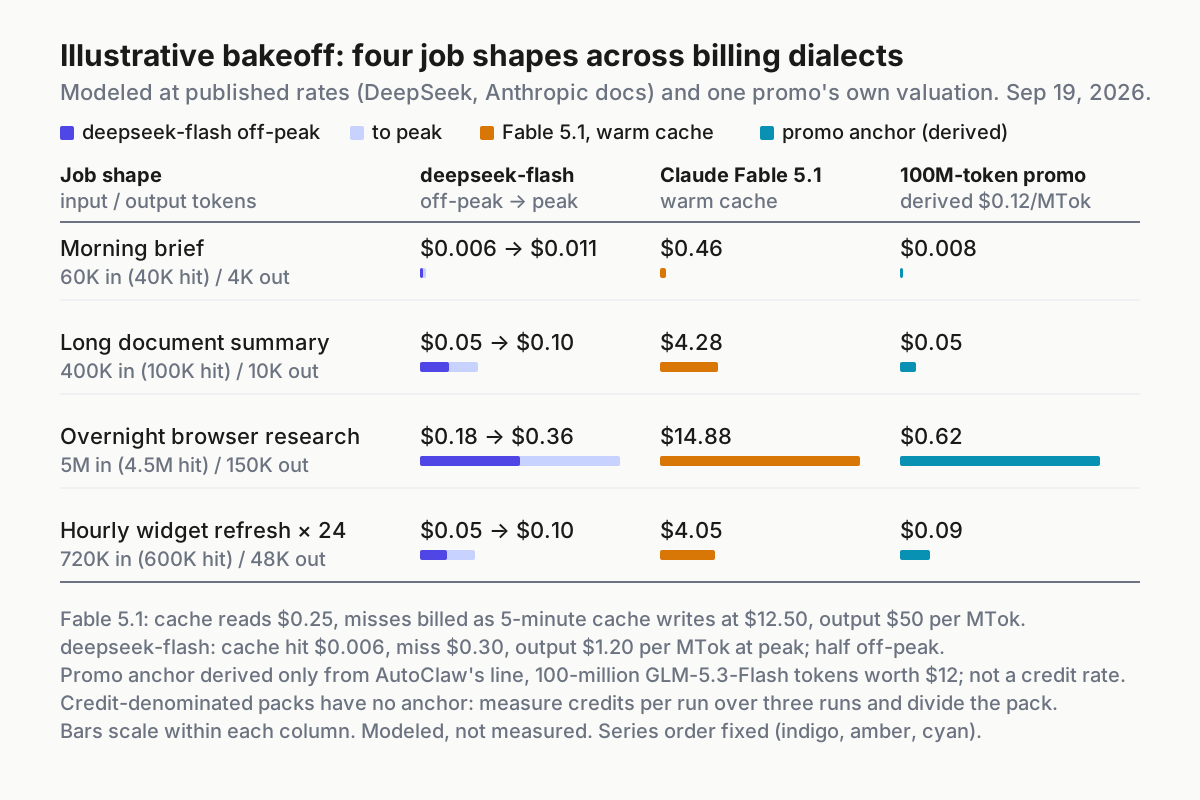 Illustrative, modeled at published rates (api-docs.deepseek.com; platform.claude.com, Sep 19, 2026) and the promo’s own valuation. Credit-denominated packs have no anchor and are measured, not modeled.
Reading it left to right. The morning brief is small on every card: $0.006 to $0.011 on deepseek-flash, $0.46 on Fable 5.1 with the cache warm, under a cent against the promo anchor. The overnight research run is where dialects separate: $0.18 to $0.36 on DeepSeek depending on the clock, $14.88 on Fable 5.1 (4.5M cache reads at $0.25, 0.5M cache writes at $12.50, 150K output at $50), $0.62 against the promo anchor. The hourly widget refresh, 24 small runs a day, lands near the long document summary on every card, which is the point of shaping jobs by schedule rather than by prompt size.
Two things the chart cannot tell you. It cannot say what a credit-denominated run costs, because no published number can; the third column is a promo denominated in tokens, and the credits column in your drill sheet is blank until you measure it. And it cannot say which agent does the job better, only what the job costs.
A cheaper run that needs a second run is the expensive one. The buy-versus-build comparison is where quality enters; here, only the meter.
The plan-decoding piece already covers what a subscription quota is. A pack is the desktop cousin of a quota, with one difference: a promo pack does not reset, it runs out, and the next one is a claim you have to make.
Step 4: One ledger of burn rate across dialects
The ledger is one file, one row per run, whatever dialect billed it. It does not convert credits to dollars; it carries both units and a burn rate per day in each. Two illustrative rows, placeholder numbers:
run_id,agent,dialect,wallet,units_before,units_after,units_spent,usd_if_known,rate_source,job_shape,started_utc,ended_utc,clock_band,notes
2026-09-18T22:05Z/research,autoclaw-research,credits,prepaid,8420,6910,1510,,measured,overnight-browser-research,2026-09-18T22:05Z,2026-09-19T01:40Z,,promo pack; median of 3 = 1480
2026-09-18T23:00Z/docs,deepseek-flash-batch,tokens,balance,,,410000,0.051,published,long-doc-summary,2026-09-18T23:00Z,2026-09-18T23:09Z,off-peak,100K hit / 300K miss / 10K out
Three derived columns make it useful. Burn per day, per agent, in that agent’s unit, over the trailing seven days. Runway, for prepaid wallets: units remaining divided by burn per day. Reserve, the runway floor that raises a flag; two days of scheduled burn is a reasonable default, because the earliest a human notices a dead overnight job is the next morning and the earliest they fix it is the one after.
The token rows carry usd_if_known because their rate is published and clock_band because on DeepSeek the same tokens cost half as much on the other side of 10:00 UTC. The credit rows carry units_before and units_after because the deduction is the only truth you have. Never fill in usd_if_known on a credit row from a guess. A blank is information; a guess is a liability that will be quoted back to you in a budget meeting.
Alerting on it is the cost-anomaly runbook with one addition: a runway alert is a floor. It fires when the number gets small, which spike detection never sees.
Step 5: Decide now what credits ran out does to scheduled work
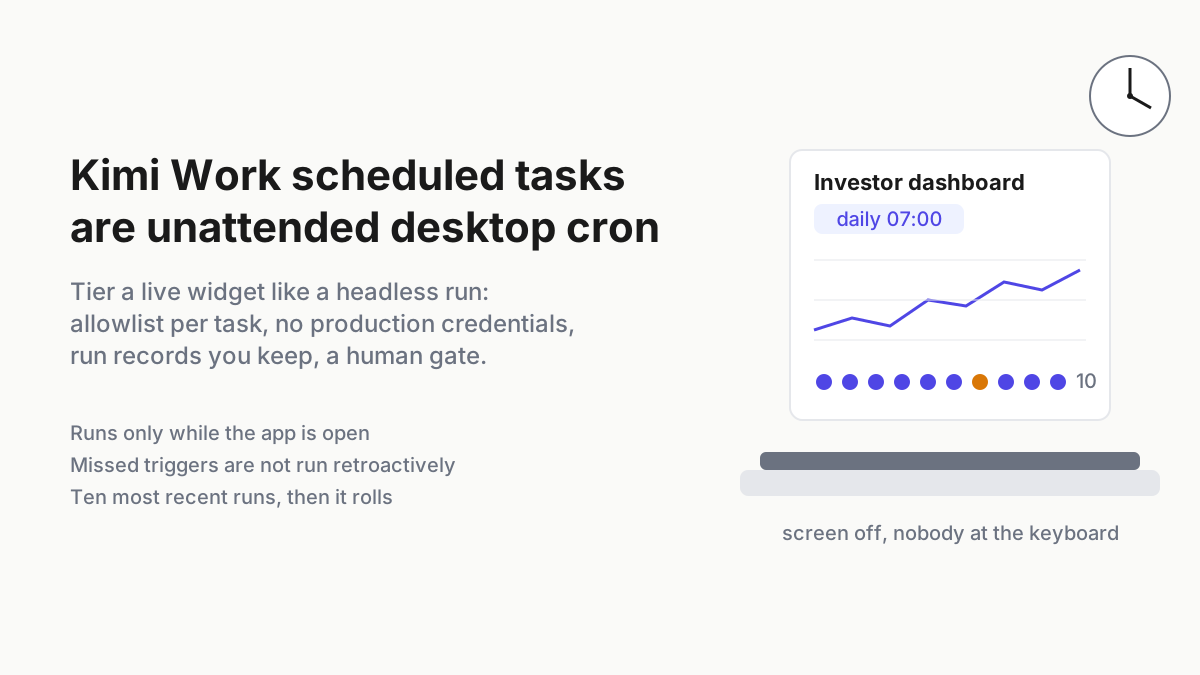
On Sep 11, 2026, Kimi Work’s release notes for 3.2.7 included “Fixed an issue where the scheduled tasks page froze when credits ran out”. That is a bug fix, and a useful one, but read what it implies: a credit balance at zero was an event the scheduler had to survive.
The help page on widgets adds the ceiling: “There is a limit on how many widget tasks can run at the same time, and it varies by plan.” And the FAQ sets the catch-up rule: “On Kimi Work desktop, scheduled tasks run locally and only execute while the app is open.” Triggers missed while the machine sleeps or the app is closed are not run retroactively when it reopens.
Put those together and a desktop scheduler on credits has three ways to skip a run: the machine slept, the app was closed, or the wallet was empty. The first two you can see in the morning. The third looks identical to a run that never fired, and nothing reruns it. AutoClaw’s pages note “Improved scheduled task reliability” in v1.16.2 and say nothing about what a scheduled task does with an empty balance, so the operator assumption has to be the pessimistic one.
The policy, written before the first pack runs low:
- Tier the schedules. Essential (the brief a human reads at 06:30), useful (hourly competitor watch), optional (refreshes nobody will miss for a day).
- Set the reserve to cover the essential tier for two days. If the essential tier burns 400 credits a day in the drill, the reserve is 800, and the runway alert fires there.
- Pause optional schedules first, at the reserve. By hand or by the wrapper, and log the pause in the ledger so the morning reviewer knows why the refresh is stale.
- Route the essential tier to the token dialect if the pack cannot be refilled in time. A morning brief costs about a cent on
deepseek-flash; a token-side twin of the essential schedule is cheaper than one missed morning. - Treat a bonus claim as a refill event rather than a windfall. Log the claim date and size; a monthly bonus that arrives on the first and a runway that ends on the twenty-sixth are the same fact.
The trust-tier side of unattended desktop schedules is its own piece. The billing side is this one: a schedule on a prepaid wallet has a runway, and the runway is a number you either computed or did not.
Five signs the credits-vs-tokens ledger has drifted
The median moved and nobody re-ran the drill. A model switch or an app update changed credits per run. Signal: units_spent on a job shape drifts more than 30 percent from the recorded median across two runs. Re-measure; do not adjust the median by hand.
A promo pack expired with balance left. Promo terms are date-bounded (the rewards post says Aug 27–30) and the countdown on the homepage modal is the only warning. Signal: units_before on the first run after the date is lower than units_after on the last run before it. Log it as an expiry, not a spend.
Granted balance masked real burn. On DeepSeek the granted balance is spent before the topped-up one, so a stretch covered by granted balance costs nothing visible. Signal: the day the topped-up balance starts moving. Baseline from that day.
A scheduled run went missing and the ledger has no row. The wallet emptied, the app was closed, or the machine slept. Signal: a gap in run_id for a scheduled job shape. The ledger cannot tell the three apart, which is the argument for the reserve in Step 5.
Two dialects got summed. Somebody added credits to dollars in a spreadsheet. Signal: a total that changes when the promo pack is re-claimed. Keep units in their own columns; the only cross-dialect number is jobs per day.
One ledger is the operating-layer answer to two dialects
A vendor’s usage view speaks its own dialect, and each is honest in it. The desk speaks several, because it runs a desktop employee on credits next to a batch API on a prepaid balance next to a postpaid frontier model, and the person at that desk is the only one who needs the three to add up in jobs per day. That is the operating bill rather than the token bill, and it is why a fleet needs one boss rather than a boss per vendor: someone who owns the ledger, the reserve, and the decision about which schedule dies first.
None of it needs a conversion rate. It needs a measured median, a published rate card, and a file that keeps them apart.
FAQ: AI credits vs tokens
How do I convert AI credits to tokens or dollars?
Usually you cannot, and you should not guess. AutoClaw publishes no credit-to-token rate; its only dollar anchor is a token-denominated promo, 100 million GLM-5.3-Flash tokens worth $12. Measure instead: run each job shape three times, record credits deducted, take the median, and divide the pack by it to get jobs per pack.
What happens to scheduled agent tasks when credits run out?
On a prepaid desktop agent, the run does not fire and nothing reruns it. Kimi Work’s notes show a scheduled-tasks page that froze when credits ran out (fixed in 3.2.7), and its FAQ says missed triggers are not run retroactively. Keep a two-day reserve for essential schedules and a token-side twin for them.
Are credits cheaper than tokens for AI agents?
The question has no answer without a job shape. Compare the same fixed job, run three times per side: credits per run against dollars per run at published token rates. The chart above shows an overnight research run from cents to about fifteen dollars across token cards; the credit side is whatever your drill measured.
Sources
- AutoClaw — new-user promo; daily free credits; plans coming soon
- AutoClaw changelog — v1.17.8 promo; v1.15.3 consumption statistics; v1.16.2 deduction fix
- AutoClaw models — five models; no prices or credit costs
- @AutoClawAIer on X — Aug 26, 2026; Ox Alpha named as GLM-5.3-Flash, rewards Aug 27–30
- DeepSeek API docs: Models & Pricing —
deepseek-flashrates; peak hours; deduction rules - Anthropic: Claude Platform pricing — Fable 5.1 rates; Claude Consumption Units, arrears only
- OpenAI API pricing — tokens, tools and container rates
- Kimi Work release notes — 3.2.7 (Sep 11, 2026), credits ran out
- Kimi Work help: Widgets — concurrency varies by plan
- Kimi Work FAQ — local schedules; no retroactive runs